
Global LNG demand is increasing
Source: METI, LNG Producer-Consumer Conference, June 2025
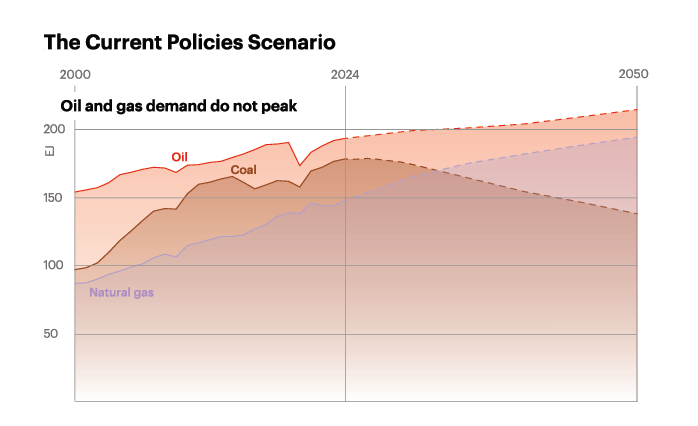
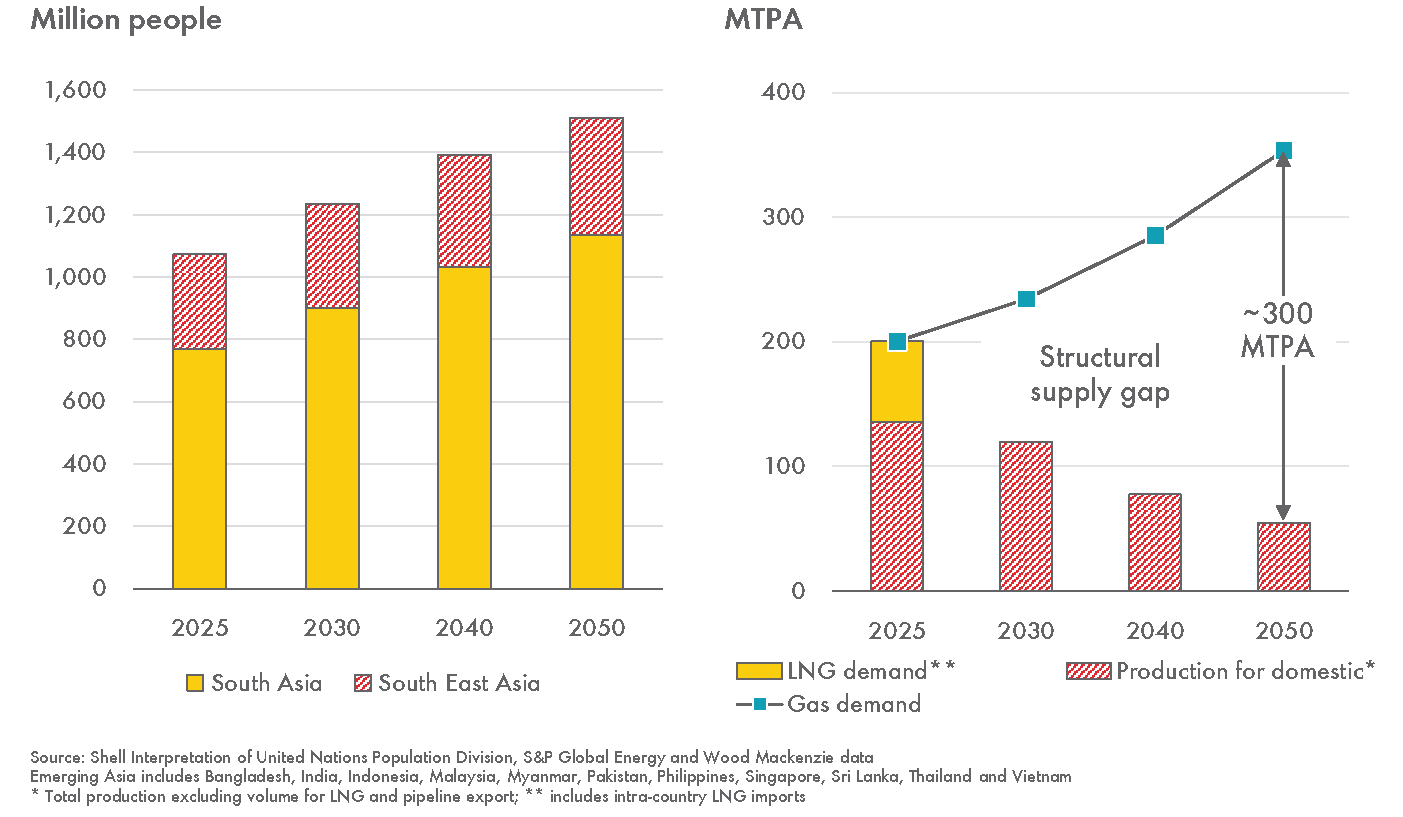
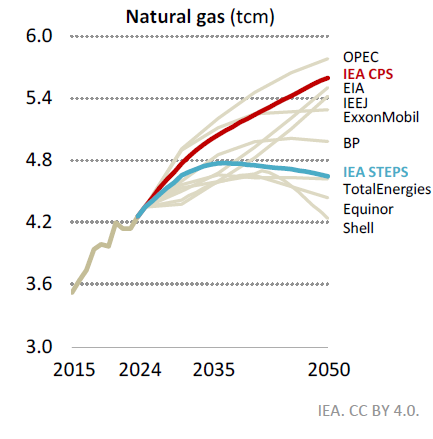
Shell’s LNG Outlook 2025 forecasts demand for liquefied natural gas (LNG) will rise by around 60% by 2040 (refer to chart above, left), largely driven by economic growth in Asia, emissions reductions in heavy industry and transport as well as the impact of artificial intelligence. Industry forecasts now expect LNG demand to reach 630-718 million tonnes a year by 2040, a higher forecast than last year. More than 170 million tonnes of new LNG supply is set to be available by 2030, helping to meet stronger gas demand, especially in Asia, but start-up timings of new LNG projects are uncertain. Shell also expect a continuing global LNG supply shortfall from about 2034.
“Upgraded forecasts show that the world will need more gas for power generation, heating and cooling, industry and transport to meet development and decarbonisation goals,” says Tom Summers, Senior Vice President for Shell LNG Marketing and Trading. “LNG will continue to be a fuel of choice because it’s a reliable, flexible and adaptable way to meet growing global energy demand.”
China is significantly increasing its LNG import capacity and aims to add piped gas connections for 150 million people by 2030 to meet increasing demand. India is also moving ahead with building natural gas infrastructure and adding gas connections to 30 million people over the next five years.
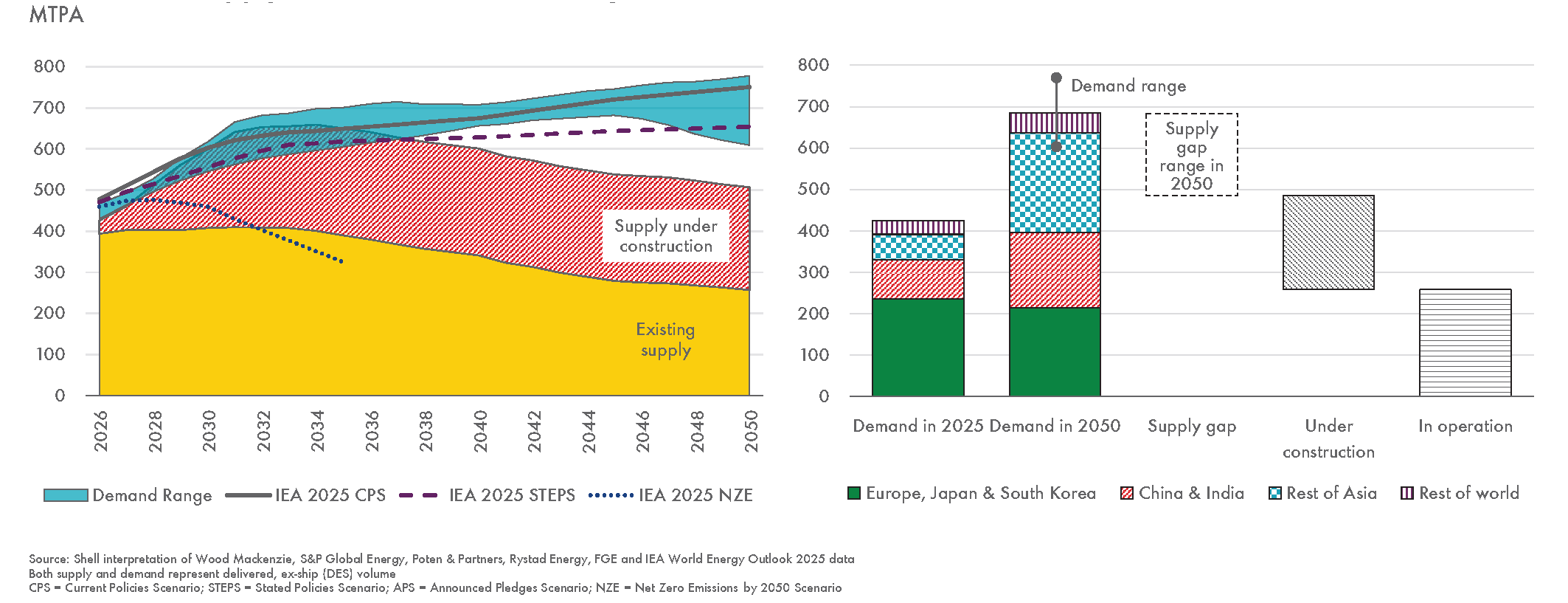
At the 2025 LNG Producer-Consumer Conference the Japanese Ministry of Economy, Trade and Industry (METI) stated LNG supply is expected to broadly align with demand scenarios projected by various institutions through the early 2030s. However, under high-demand scenarios, supply could become tight in the latter half of the 2030s (refer to chart above, right). On the supply side, projections are subject to significant uncertainty in the energy market, with the realization of planned and future LNG projects dependent on investment profitability and access to financing. On the demand side, particularly in emerging economies across Asia, it is important to recognize that demand levels may fluctuate depending on gas price trends, as these economies continue to grow. Under various Net-Zero scenarios an LNG surplus is forecast, but current evidence strongly suggests that the world will fall well short of Net-Zero by 2050, given the huge investments required and the potentially negative economic consequences on the way to getting there.
In the METI’s view, economic growth is expected to drive a continued increase in energy demand, and natural gas, including LNG, is anticipated to play an important role in meeting this growth. Gas-fired power plants contribute to power system stability by balancing the intermittency associated with the expansion of renewable energy. Additionally, as gas-fired generation emits fewer greenhouse gases than coal, fuel switching can support emissions reductions. Moreover, existing gas and LNG infrastructure can be repurposed for emerging low-carbon fuels such as biogas, e-methane, hydrogen, and ammonia, offering further decarbonization potential across the energy value chain. As such, LNG is expected to retain an important role during the energy transition.
Investment in upstream natural gas assets declined between 2015 and around 2020. This was due to a combination of factors, including the oil price decrease, policy and demand uncertainty following the Paris Agreement, increasingly stringent regulations on upstream oil and gas investments, and a strategic shift among energy companies toward renewables. Additionally, energy companies with high leverage suffered from the sharp decline in oil prices. However, since 2021, heightened concerns over energy security, particularly following Russia’s invasion of Ukraine, and the associated spike in commodity prices have reignited upstream investment. Investment in LNG liquefaction projects, which had been constrained during the oil price slump, surged in 2018–2019 in anticipation of the increase of oil price and demand recovery. In 2019, the volume of liquefaction capacity reaching final investment decision (FID) marked a record high. Since 2021, large-scale projects such as Rio Grande Phase 1, Port Arthur Phase 1, and Plaquemines Phase 2 in the United States, and the North Field expansion in Qatar, have also reached FID, pushing liquefaction investment volumes upward.
Remarkably, Australia has not played a major role in this LNG investment surge.
Natural gas is essential for the global energy transition, as evidenced by growing LNG demand
Since the outbreak of the conflict in Ukraine, European and Asian countries more than most have recognized that they must reduce reliance on any one region or country’s supply of energy including natural gas.
Natural gas is both a transition and a destination fuel. Natural gas and LNG are essential for the energy transition as they play an instrumental role in shifting away from coal and moving toward net-zero emissions. As the transition evolves, natural gas will remain vital in providing reliable and efficient energy to support economies in different parts of the world including Australia and all of Asia.
The re-drawing of global energy supply maps is pushing natural gas and LNG demand to new heights and spurring new off-take contracting and other activities and opportunities for companies like Gulf Energy, for example:
Natural gas is set to drive Africa’s next energy growth phase, with sub-Saharan Africa—rather than traditional hubs like Egypt and Algeria—expected to deliver most of the continent’s future gas and LNG expansion. LNG exports from sub-Saharan Africa are forecast to jump ~175% by 2034. Reforms and major FIDs are unlocking investment, with Nigeria securing over $8 billion in gas project approvals, Mozambique restarting stalled mega-projects, and Tanzania moving closer to a final investment decision that could reshape its economy. (OilPrice.com, 3 January 2026)
U.S. liquefied natural gas exports set new records in 2025 as new capacity came online and existing terminals ran at high utilization, pushing annual shipments past levels previously thought years away. Preliminary data from LSEG show the United States exported 111 million metric tons of LNG last year, making it the first country to surpass the 100-million-ton threshold in a single year. That volume puts U.S. exports nearly 20 million tons ahead of Qatar and about 23 million tons above 2024 levels, reinforcing the country’s position as the world’s largest LNG supplier. (OilPrice.com, 2 January 2026)
Russia’s Novatek exported 21 cargoes of liquefied natural gas to China from its Arctic LNG 2 facility last year, data from Kpler cited by Reuters has shown. Arctic LNG 2 is under EU and U.S. sanctions. (OilPrice.com, 2 January 2026)
With energy security still at the forefront, several liquefied natural gas (LNG) projects have been given the green light to proceed to production mode across the globe, with the United States (U.S.) running the show. As a result, 2025 marked the start of the next wave of LNG projects that are anticipated to enrich the global energy mix. (Offshore Energy, 1 January 2026)
See past activities and opportunities for companies like Gulf Energy below:
Future global LNG demand will come mainly from Asia, and the Bamaga Basin (Q/23P) is ideally located to supply that market
Australia is ‘location competitive’ for much of Asia
Asia’s demand for LNG is forecast to surge, but Australia hasn’t found and developed enough new gas to remain a major global LNG supplier
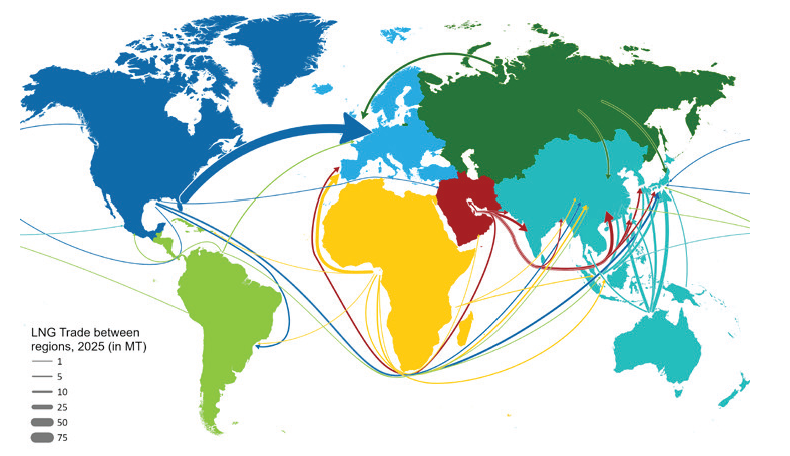
Australia is closer to most high potential Asian markets than its biggest LNG exporting competitors, Qatar and the USA.
Australia has failed to maintain a steady stream of new gas production projects being brought online.
More than $200 billion of LNG projects were approved for final investment decisions (FIDs) in Australia before 2012. Since then, the Woodside Scarborough Project (Pluto Train 2 Expansion) and the Santos Barossa Project are the only LNG projects to reach FID, with the latter being primarily a backfill project to extend the life of the Darwin LNG facility.
Without further investment in new LNG trains and upstream infrastructure, Australia will lose its position as a major LNG exporter and will almost certainly lose its energy security.